Instructions #
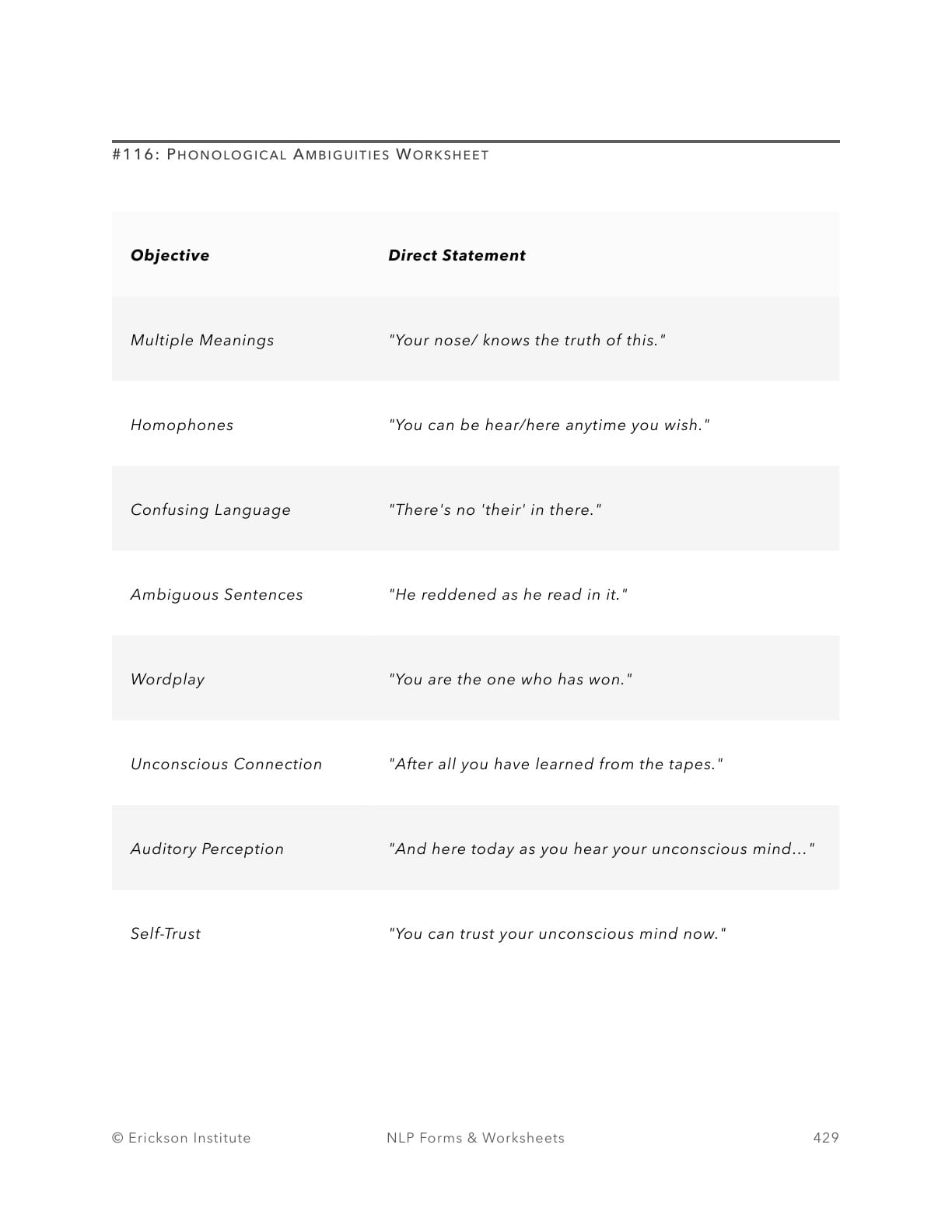
Words or phrases with multiple meanings but the same sound are referred to as phonological ambiguities. Because of the similarity in pronunciation, these linguistic constructs cause confusion or ambiguity in the listener’s mind.
Phonological ambiguities are used in neurolinguistic programming to distract the conscious mind and induce a state of trance.
The listener’s conscious mind becomes engaged in deciphering the intended meaning when statements or questions contain words with multiple meanings or homophones.
This cognitive processing effort disrupts conscious awareness for a short period of time, allowing the unconscious mind to become more receptive to suggestions and information.
The goal of phonological ambiguity in NLP is to avoid conscious resistance and facilitate a shift in perception or behavior at the unconscious level.
As the listener tries to make sense of the linguistic ambiguities, they enter a trance-like state in which their focus turns inward, making them more susceptible to suggestion and influence.
Examples of phonological ambiguities can be used in therapy to induce trance and a receptive state in the client.
The therapist strategically disrupts the conscious mind’s logical processing by using words or phrases with multiple meanings or similar sounds, such as “your nose knows the truth of this” or “you can be heard here anytime you wish,” leading to a heightened state of receptivity and facilitating therapeutic outcomes.
Worksheet #
Source #
Access the full suite of 500 therapy and coaching templates. This worksheet features in my book, available on Amazon:
500 Practical NLP Forms, Templates & Worksheets: For Therapy, Coaching & Training