Instructions #
Fear of failure is not an inherent trait but rather the result of cognitive-behavioral choices people make in response to difficult situations.
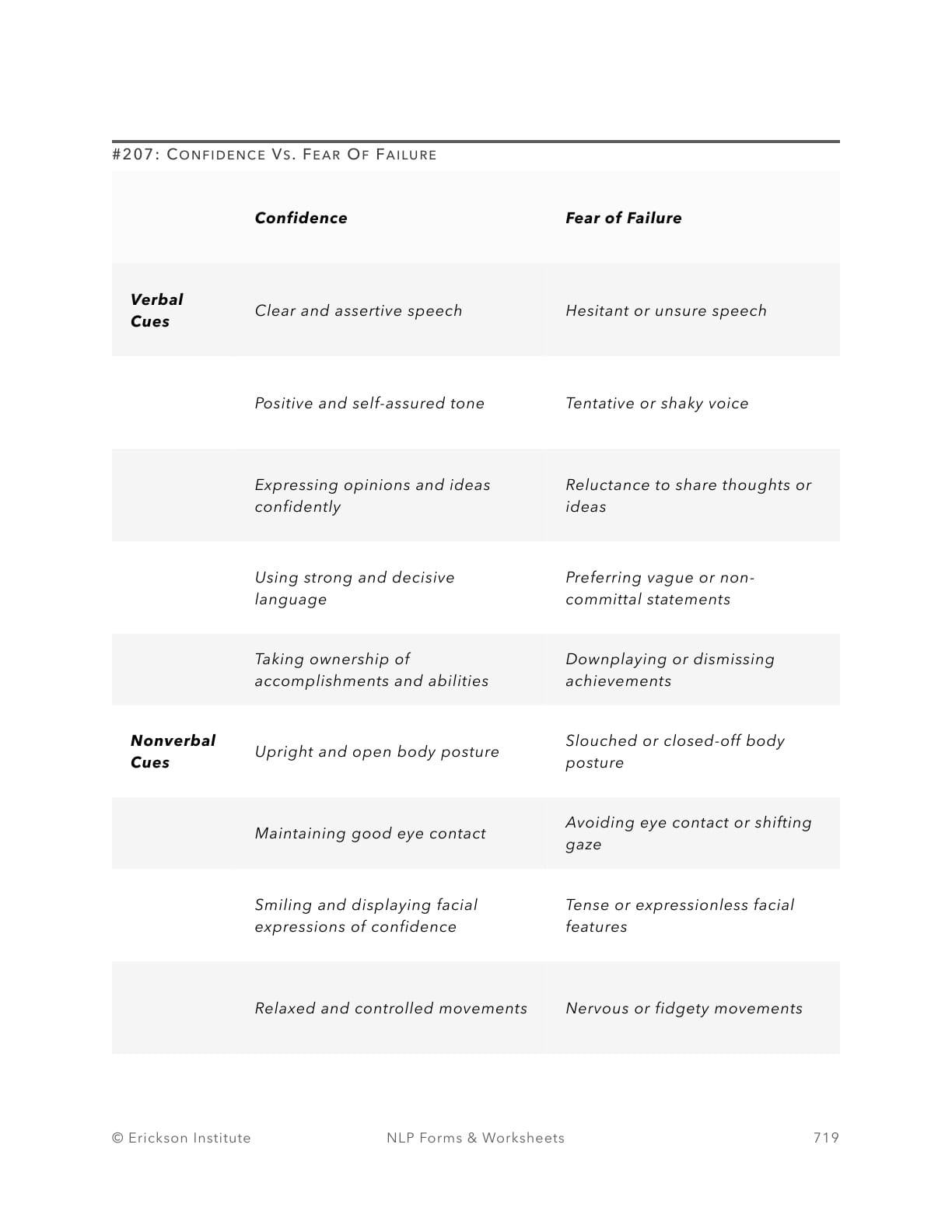
It is critical to recognize that just as easily as one engages in fear-based cues, they have the ability to recognize their current choices and consciously shift towards confidence cues.
Clients can actively challenge the negative beliefs and self-doubt that contribute to the fear of failure by bringing awareness to their thoughts and behaviors.
This entails consciously choosing to engage in confidence-building cues such as assertive language, maintaining an open and upright posture, and approaching challenges with a positive attitude.
Recognizing the impact of their cognitive choices allows people to take control of their fears and develop a stronger sense of self-assurance.
They can rewire their cognitive patterns with practice and repetition, gradually replacing fear-based cues with confidence-building ones.
Clients can develop resilience and a growth-oriented mindset by focusing on their strengths, setting realistic goals, and viewing failures as learning opportunities.
Clients can work with therapists to shift their cognitive choices and transform their fear of failure into a confident and empowered outlook, allowing them to pursue their goals and aspirations with renewed zeal.
Worksheet #

Source #
Access the full suite of 500 therapy and coaching templates. This worksheet features in my book, available on Amazon:
500 Practical NLP Forms, Templates & Worksheets: For Therapy, Coaching & Training