Instructions #
The goal of this technique and the worksheet that goes with it is to provide a framework for understanding your emotional patterns and developing effective strategies for managing your responses.
You can become more aware of the sub-modalities and patterns associated with both limiting and positive emotional states by engaging in a structured exploration of past experiences.
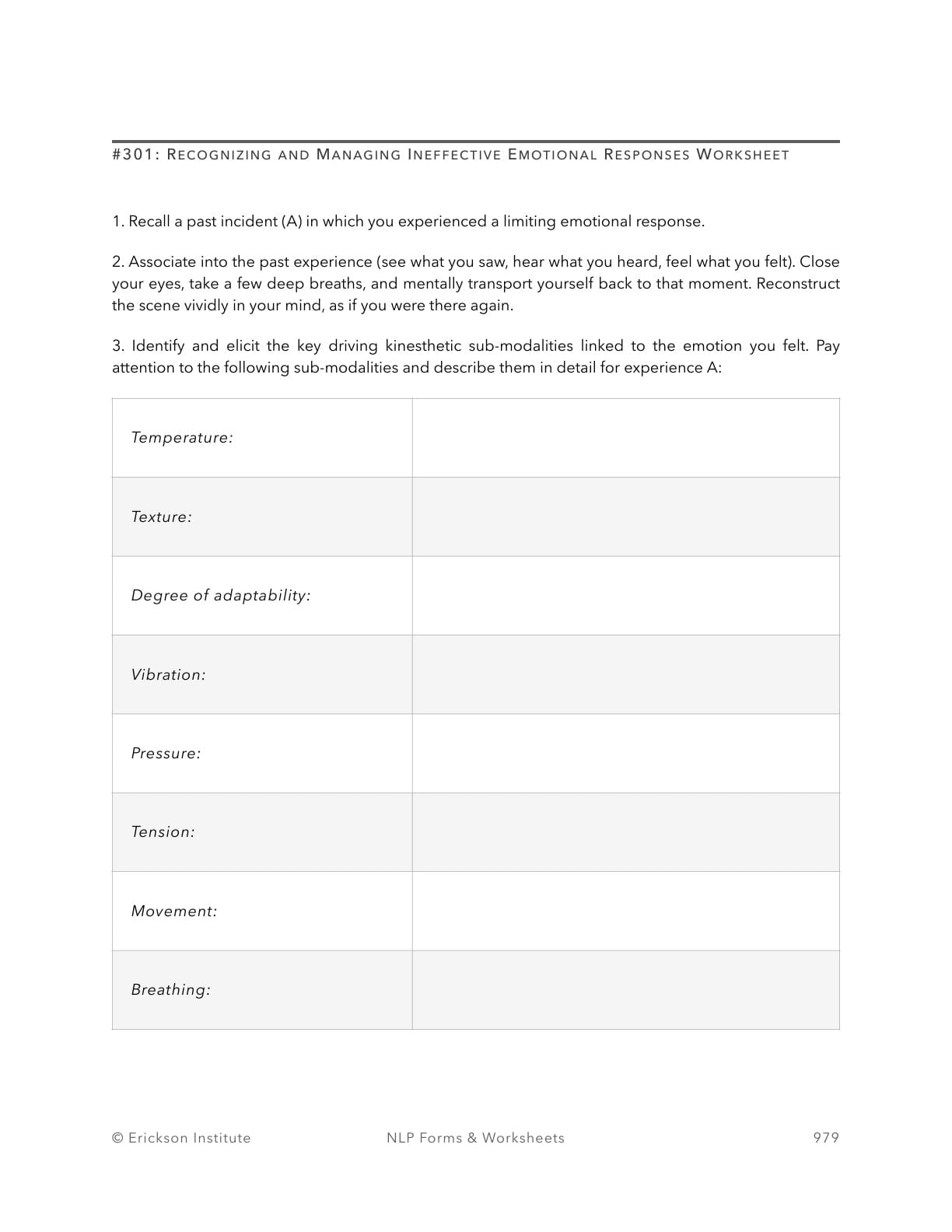
The worksheet walks you through the process of recalling and associating specific incidents, as well as investigating the kinesthetic, visual, and auditory sub-modalities that contribute to your emotional experiences.
You can identify key differences and commonalities in how you interpret and respond to similar events by comparing and contrasting two experiences with similar emotional states but different outcomes.
You gain a better understanding of the sub-modalities that drive your emotional responses as a result of this process, allowing you to identify and manage ineffective patterns.
You can develop more resourceful emotional shift strategies by identifying the sub-modalities that facilitate smoother transitions between positive and negative interpretations.
Finally, the goal of this technique is to help you become more self-aware, recognize your emotional triggers, and consciously choose more adaptive and empowering responses in a variety of situations.
Worksheet #


Source #
Access the full suite of 500 therapy and coaching templates. This worksheet features in my book, available on Amazon:
500 Practical NLP Forms, Templates & Worksheets: For Therapy, Coaching & Training