Instructions #
In therapy sessions, we tell our clients that their emotional reactions are in fact within their realm of responsibility. Supposedly, someone else said something, and shortly after, you felt anger bubbling up inside of you. You react with annoyance and spite.
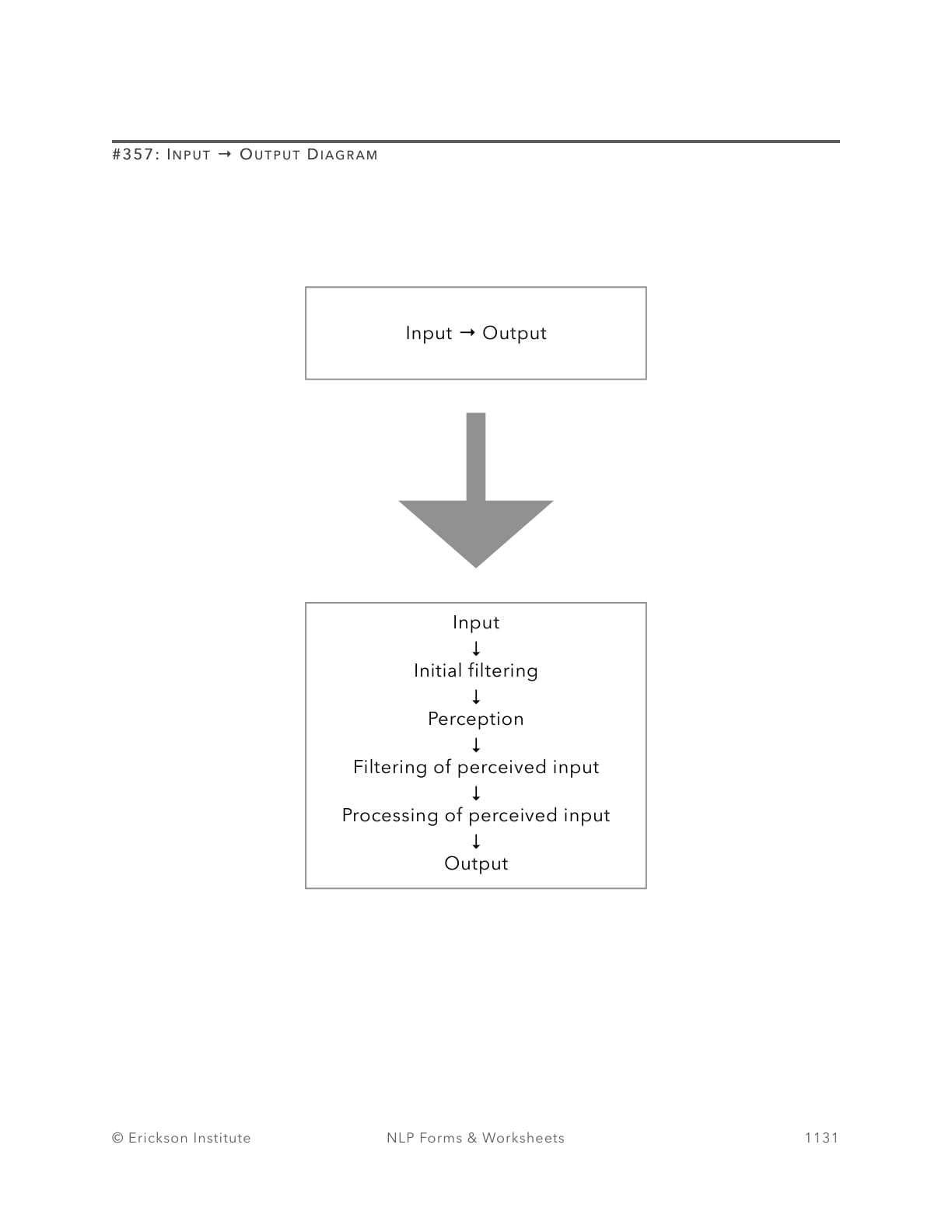
If your reasoning for feeling angry is: “It’s your fault, you made me angry!”, the meaning is “what you said made me angry” (as it was not the mere fact that this person exists that made you angry, but his words) and it can be represented as: “What you said” → “My angry reaction” = Words → Feelings.
That gives quite a lot of power to entities outside your nervous system, does it not? In reality, though, that is too simplistic and far from what goes on within your organism.
The actual process looks more like this: Input - the sensory stimuli in current reality - everything that happens around and within you at any given moment. Initial filtering - of all stimuli that is entering your five senses.
Perception - the result of the initial filtering, which means transforming the stimuli from the environment into cognitive data for further processing.
Filtering of perceived input - This process prioritizes the available stimuli (now cognitive data) that entered the system according to what seems more important and requires conscious attention.
For example, a sudden horrific crash from a car down the street would take precedence over the birds singing on the tree right next to you or even a conversation you’re emerged in with another person.
Processing of perceived input - here we have a complex of many sophisticated processes, below conscious level, that in the simplest terms answer the questions “what does it mean for me?”, and “how do I respond?”.
Output - the resulting behavior or kinesthetic reaction (emotions).
Worksheet #
Source #
Access the full suite of 500 therapy and coaching templates. This worksheet features in my book, available on Amazon:
500 Practical NLP Forms, Templates & Worksheets: For Therapy, Coaching & Training