Instructions #
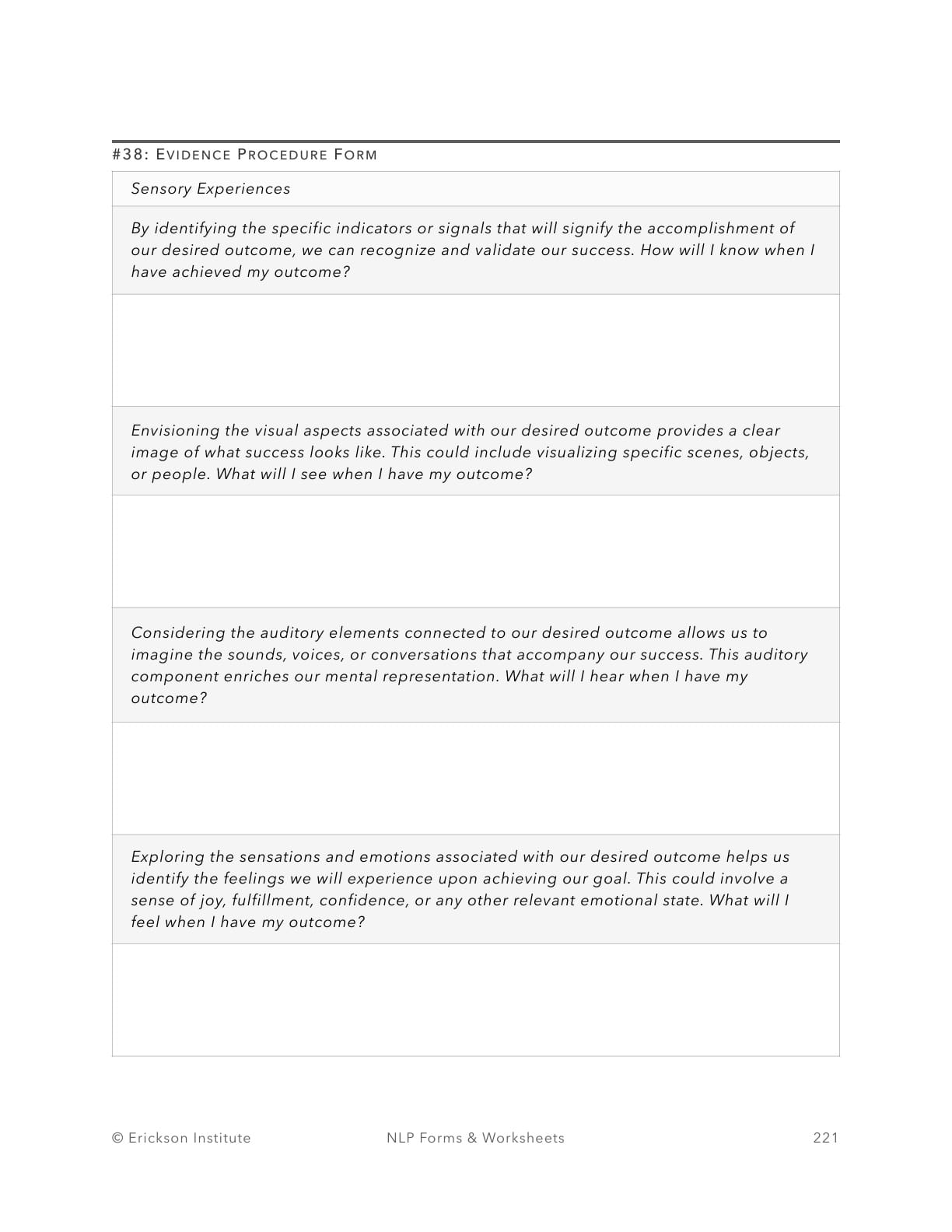
The evidence procedure is a process used in Neuro-Linguistic Programming (NLP) to determine whether or not a desired outcome was achieved. It entails developing sensory-based criteria or indicators that serve as evidence of the desired outcome being achieved.
Outcomes in NLP are frequently defined in terms of sensory experience, such as what we see, hear, and feel.
We create a benchmark or reference point for assessing our progress and determining whether we have achieved the desired result by identifying these sensory elements associated with the desired outcome.
The evidence procedure works by asking questions such as, “What will I see, hear, and feel when I have my outcome?” These questions compel us to vividly imagine the sensory aspects associated with the desired result.
We establish a clear and measurable reference for determining success by visualizing, auditoryizing, and feeling these sensory components. We can compare our actual experiences to the imagined sensory representations once we’ve established the sensory criteria for the outcome.
We can conclude that we have achieved our goal if our real-life experiences match or closely resemble the sensory elements we have defined.
The evidence procedure is a powerful tool for self-evaluation and goal attainment because it provides concrete evidence and feedback to guide our actions and progress toward our desired outcome.
Worksheet #
Source #
Access the full suite of 500 therapy and coaching templates. This worksheet features in my book, available on Amazon:
500 Practical NLP Forms, Templates & Worksheets: For Therapy, Coaching & Training