Instructions #
Eye Accessing Cues are a Neuro Linguistic Programming (NLP) concept that proposes a link between eye movements and the sensory representational systems that people use to process information.
When people access different types of information or engage in different cognitive processes, their eye movements tend to follow certain patterns, according to the eye accessing cue model.
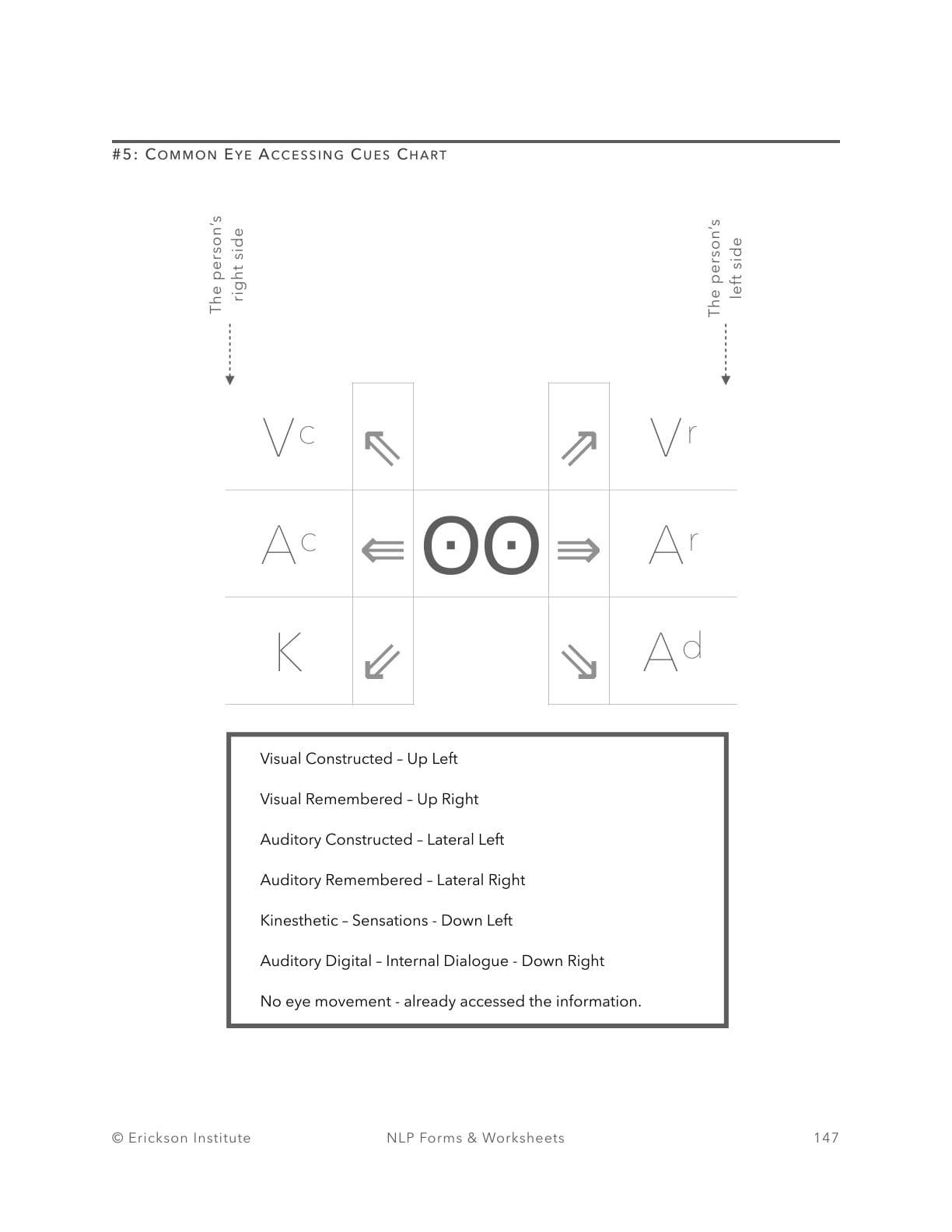
According to the eye accessing cue model, eye movements can reveal information about an individual’s preferred representational system: Visual Construct: It is thought that when a person looks up and to the left (from their perspective), they are accessing visual imagery or constructing visualizations.
Visual Remembered: It is thought that when a person looks up and to their right (from their perspective), they are accessing visually remembered information or recalling visual memories.
Auditory Construct: Accessing auditory constructs, such as creating or imagining sounds, is associated with looking horizontally to the left (from their perspective).
Looking horizontally to the right (from their point of view) is thought to indicate accessing auditory remembered information, such as recalling sounds or conversations.
Kinesthetic/Feeling: From their perspective, looking down and to the right is associated with accessing kinesthetic or feelings-based information, such as emotions, sensations, or bodily experiences.
Looking down and to the left (from their perspective) is thought to indicate internal auditory dialogue or self-talk.
It should be noted that eye accessing cues are not absolute indicators of a person’s thought processes or representational systems. They should be interpreted cautiously and in conjunction with other nonverbal cues and contextual information.
The eye accessing cue model is a tool used by NLP practitioners to improve communication and build rapport by adjusting their language and approach based on the client’s observed eye movements.
While the Neuro Linguistic Programming (NLP) Eye Accessing Cues model suggests specific correlations between eye movements and representational systems, it is important to note that clients’ eye accessing cues may vary.
People’s eye movements can vary or display a mix of cues depending on a variety of factors such as personal preferences, cultural influences, and individual differences in cognitive processing.
Some people may have “reversed” eye accessing cues, which means their eye movements are opposite of what the model predicts. A person accessing visual imagery, for example, may look down and to the left rather than up and to the left.
Individual differences could be influenced by a variety of factors, such as handedness, cultural background, or personal experiences.
Furthermore, some people may have subtle or less pronounced eye accessing cues, making accurate interpretation of their eye movements more difficult.
In such cases, NLP practitioners or observers must take a holistic approach, paying attention to nonverbal cues, verbal language patterns, and contextual information.
Effective communication and rapport building require a thorough understanding of the client’s communication style and preferences that extends beyond eye contact.
It is critical to approach the NLP Eye Accessing Cues model with caution and avoid treating it as a fixed indicator of an individual’s cognitive processes.
In NLP, effective interaction and rapport building requires adapting and adjusting communication strategies based on multiple cues and feedback from the person.
Worksheet #
Source #
Access the full suite of 500 therapy and coaching templates. This worksheet features in my book, available on Amazon:
500 Practical NLP Forms, Templates & Worksheets: For Therapy, Coaching & Training