Instructions #
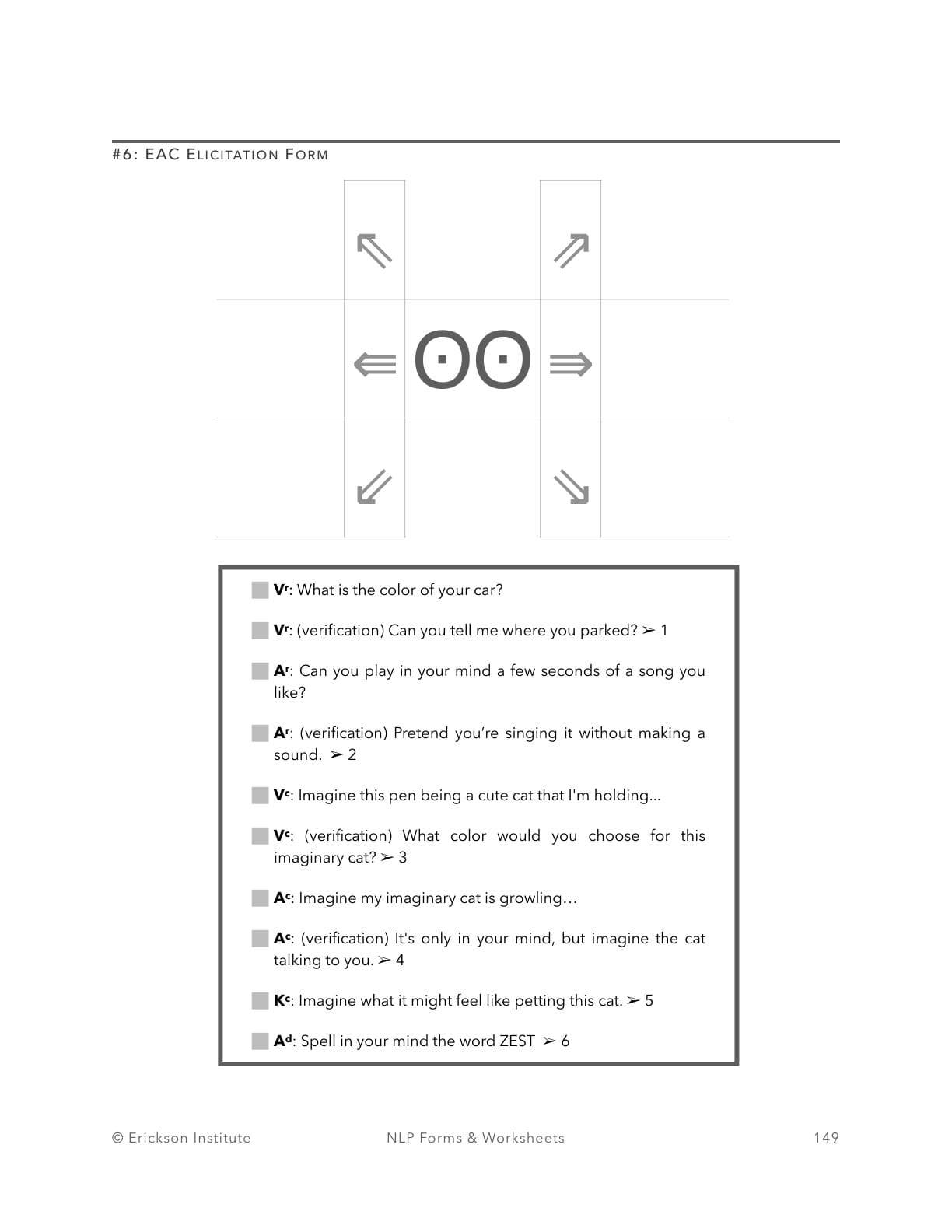
In Neuro Linguistic Programming (NLP), eliciting Eye Accessing Cues (EAC) is important because it provides valuable information about an individual’s preferred sensory representational systems.
Practitioners can gain insights into how a person processes and represents information internally by observing and identifying patterns of eye movements. This knowledge enables more effective communication, rapport-building, and comprehension.
The importance of eliciting EAC lies in the ability to more accurately determine a person’s sensory modalities.
Understanding a person’s preferred representational system allows NLP practitioners to tailor their language and communication style to the person’s internal processing.
Because it allows the practitioner to speak in a way that resonates with the client’s preferred sensory channels, this alignment improves rapport and connection.
For example, if a person exhibits consistent eye movements indicating a visual representational system, a practitioner can use visual language, visual examples, or visualizations to improve communication.
This results in a more impactful and engaging experience for the client, allowing for greater comprehension and receptivity. EAC also aids in identifying any discrepancies or inconsistencies between a person’s verbal and nonverbal cues.
If someone claims to be visually impaired but consistently exhibits eye movements associated with another representational system, this may indicate a mismatch between their self-perception and their actual cognitive processing.
This insight can direct the practitioner’s further investigation and facilitate alignment between the person’s conscious and unconscious communication and perception patterns.
Worksheet #
Source #
Access the full suite of 500 therapy and coaching templates. This worksheet features in my book, available on Amazon:
500 Practical NLP Forms, Templates & Worksheets: For Therapy, Coaching & Training